
As the Bubble Bursts, Who Dominates Attention in the AI Era? A 2026 Guide to Influential AI KOLs in China and the UK

 Prefer us on Google


Author: Alan, Amelia | Biteye Content Team; Denise | XHunt Operations Team
In the summer of 2026, the information flow on social platforms refreshes in milliseconds. One moment, a major language model releases an update; the next, thousands of "in-depth analyses" flood the scene.
An independent developer told us that the first thing he does every day upon waking is no longer scrolling through his timeline, but quickly scanning a few familiar avatars to see what new tricks they have coded the night before.
"I only trust those who have practical experience," he said.
This seemingly paranoid trust points to a truth that most people overlook:
In today's rapid advancement of large model technology, general information itself is depreciating at lightning speed.
Traditional tech media accounts that relied on aggregating news, translating overseas announcements, and piecing together stories have gradually lost users' patience. The real scarce resource is no longer "who said what first," but rather "who can tell me whether this is reliable and how I can use it."
To uncover the true operational logic of this hidden circle, we conducted an in-depth analysis of nearly 400 leading AI KOLs in both Chinese and English ecosystems, using exclusive data and capability models from the social analysis tool @xhunt_ai.
We found that the opinion leaders in the AI era are undergoing a profound transformation from "information intermediaries" to "productivity enablers."
1. Core Finding: From Distributing Opinions to Distributing Productivity
In the traditional internet context, an individual with a brilliant idea needs to mobilize a complex chain of human resources to bring that idea to fruition: backend, frontend, UI, product managers... The lengthy collaboration process can sap much of the enthusiasm. Today, AI tools have drastically compressed this production chain. Codex, Claude Code, Cursor, and Lovable have transformed programming barriers into logical and structural capabilities; Seedance, GPT Image, Keling, and Nano Banana have directly eliminated the complexities of image and video production.
However, this has led to an counterintuitive industry phenomenon: when anyone can use AI to churn out lengthy articles in bulk, high-quality content becomes "cheap" and readily available, while trust becomes more scarce than ever.
The core value of AI KOLs lies not in their ability to make AI generate content faster than ordinary people, but in their capacity to first visualize the vague power of AI through human-machine collaboration into results that others can see, run, and directly reuse. This is no longer about distributing opinions, but about distributing productive capabilities.
For instance, when a new model claims to "defeat Claude Opus 4.7," users are already tired of the same old press releases. They eagerly want to know from trusted KOLs: "Will it hallucinate in real code development? Is this product, which looks incredibly cool in the official polished video, really a productivity tool that ordinary people can use right out of the box?"
The attention compass has clearly reversed: from "what happened" to "is it important," and now to "how to use it."
In a noisy environment, AI KOLs play the role of practical pioneers and trust anchors.
2. Who Plays This Role: Veteran Technologists and New Generation Blue Ocean
A common industry bias is that "most AI KOLs are marketing accounts that quickly gained traction after the explosion of ChatGPT at the end of 2022." However, XHunt's generational statistics on account registration time refute this claim: the generational structure of AI KOLs presents an inverted pyramid distribution.
Dominance of seasoned professionals: Among the English rankings, early users registered between 2007 and 2015 account for as much as 62.9%; this proportion reaches 58% in the Chinese rankings. This means that the majority of the leading accounts active in the core AI circle today are practitioners and entrepreneurs who have emerged after experiencing the PC, mobile internet, and Web3 cycles. As the wave of large models arrives, they have keenly completed the migration of productivity tools.
Growth of the new generation in the Chinese region: Notably, during the ChatGPT explosion period from 2022 to 2023, the proportion of newly emerged AI-native accounts in the Chinese region reached 13.0%, higher than the 9.7% in the English region. This indicates that the Chinese ecosystem offers significant traffic rewards for practical content; as long as the tools are proficient and the tutorials solid, new accounts can establish competitive advantages through continuous posting.
In contrast, the registration times of Web3 KOLs often show a clear spindle shape, with a surge of new accounts during the DeFi Summer, NFT explosion, and Meme craze periods, coinciding with market heat.
3. The Symbiotic Evolution of AI KOLs and OPC
The evolution of AI is transforming the concept of One Person Company (OPC) from a superhuman concept into a clearly actionable reality. The core essence of OPC is that users can sensitively call upon various vertical AI agents, liberating themselves from solitary battles and the burden of all the hard work, infinitely amplifying their ideas, and using AI to complete independent product construction, commercial distribution, and precise marketing.
In this transformation, "application distribution" AI KOLs have firmly established their core ecological position through their composite advantages:
Understanding technical boundaries: They often come from major AI companies or are seasoned developers, possessing foundational technical knowledge that makes them more aware of the real limitations of tools than pure marketers.
Understanding market pain points: As long-term content creators facing audiences, they have a strong sense of productization and marketing, making them more attuned to real needs than pure developers.
It is this dual Buff of "technology + market sense" that allows them to convert abstract technology into usable scenarios through public building (Build in Public), thereby continuously accumulating user trust.
The explosive trend of Vibe Coding has pushed this personal IP tension to the extreme: when a leading AI KOL recommends a development framework, they no longer just write a few bland lines of recommendation, but directly demonstrate on X how they can quickly launch a complete, interactive AI application in 15 minutes, collaborating with the model using just a natural language command, all while maintaining a relaxed atmosphere.
Traditional KOLs harvest traffic by distributing opinions, while AI KOLs consolidate the ecosystem by distributing productive capabilities.
4. Data Portraits: Ecological Divides Between Eastern and Western KOLs
To explore the true operational logic of the AI KOL ecosystem, this report extracted 100 tweet samples from the top 300 English AI KOLs and the top 100 Chinese AI KOLs ranked by XHunt's influence over the past three months, conducting in-depth calculations and comparisons of their tweet content and various metrics.
We found that there are significant differences between Chinese and English AI KOLs in terms of attention structure and content production models. The following will reveal the true face of AI KOLs across seven core dimensions: traffic volume, discussion fields, account creation time, and personal profiles.
Attention Map: English Region Focuses on Sources, Chinese Region Focuses on Practice
Traffic volume distribution: The total number of followers in the English rankings exceeds 350 million, with an average of 1.17 million and a median of 110,669. The Chinese ecosystem leans towards refined vertical fields, with an average follower count of about 77,000 and a median of 43,006.
Posting activity comparison: In the past 90 days, the 100 accounts in the Chinese rankings produced nearly 30,000 tweets, with a median posting volume of 210 tweets. In contrast, the 300 English accounts produced only 37,000 tweets in total, with a median of just 38 tweets. Leading English accounts often post infrequently, while Chinese accounts form a high-frequency application diffusion network.
Follower tier structure: The English rankings present a pyramid structure, with accounts having 50,000 to 200,000 followers accounting for the highest proportion at 41.8%, while accounts with over 1 million followers make up 7.4%. The Chinese rankings, on the other hand, concentrate on the long-tail application layer, with accounts having 10,000 to 50,000 followers accounting for 53.0%, and those with over 200,000 followers only accounting for 4.0%.
KOL followers: Although the average number of followers in the English rankings (510.7) is higher than that in the Chinese rankings (320.2), when adjusted for the base of Chinese and English AI KOLs (approximately 1,000 and 5,000 respectively), the penetration rate of top Chinese KOLs reaches 32%, far exceeding the 10% in the English region. This indicates that the Chinese AI KOL circle is a tightly connected, high-density community.
Activity map: As high as 70% of Chinese KOLs share industry dynamics and practical insights daily. In contrast, 39.8% of low-frequency active accounts in the English region are isolated, while 26.4% are stably active. The English region leans towards an industrial source network, while the Chinese region focuses on a practical network.
In summary: English AI KOLs are part of an industrial source network that masters first-hand technology and major strategic releases; Chinese AI KOLs are a super diffusion and practical network that translates, evaluates, and tutorials cutting-edge technology for mainstream workflows.
Mental Preferences: English Region Focuses on Macro, Chinese Region Focuses on Practicality
Peeling back the broad labels, we can clearly see the focus of the two ecosystems through frequency and tag extraction from the general discussion content:
Whether in the English or Chinese region, foundational models, AI intelligences, AI commercialization, and AI programming are the common axes of consensus, but the paths they extend outward are starkly different:
The English region emphasizes underlying technology and macro perspectives: English KOLs have far higher coverage rates in AI commercialization (44.7%), foundational models (39.6%), AI safety (13.8%), AI chips (12.6%), and embodied intelligence (5%) compared to the Chinese region. They devote significant energy to discussing the safety alignment of AGI, supply-demand patterns of computing power, open-source vs. closed-source battles, and embodied intelligence.
The Chinese sector focuses on practical applications and operational guidance: Chinese KOLs have demonstrated a strong pragmatism. AI programming stands at 72.1%, nearly double that of the English sector. AI agents score 51.5% compared to 39% in the English sector. In visual generation, the data is still close to double that of the English sector at 20.6%. Tool evaluations are at 11.8%, almost nine times higher than in the English sector. Tutorials and prompts are also significantly higher than in the English sector, indicating that Chinese bloggers are better at breaking down complex technologies into specific operational guides such as coding and agent building.
Capability Radar: English Focuses on Technical Insights, Chinese Focuses on Full-Stack Applications
To reduce misjudgments of major category labels, we utilized XHunt's KOL capability scoring model to comprehensively analyze the content quality published by AI KOL accounts across multiple scoring dimensions:
The English leaderboard occupies the source and underlying logic of the industry: The highest score on the English leaderboard is multimodal at 88.3, followed by foundational models and prompts. Their core capabilities lie in insights into model architecture, large-scale engineering tuning experience, and foresight of cutting-edge trends. In the fields of AI safety and chips, the English leaderboard has a natural first-mover advantage.
The Chinese leaderboard focuses on full-stack application practices: In the Chinese sample, the average correlation of AI programming ability reached 88.9, and AI agents reached 87.1. A large number of creators with natural language development capabilities are active on Chinese Twitter, adept at monetizing AI in private domains or light entrepreneurial models.
Mention Rate of Large Models: A Workflow Map of Voting with Feet
The mention rate of large models (i.e., any tweet from an account hitting keywords within three months) not only represents the discussion heat of the large models themselves in the community but also reflects the degree of reliance and sentiment of KOLs towards various models in their actual workflows, a "vote with their feet":
As shown in the figure, Claude and GPT form the kings of bilingual models. In the Chinese sector, the mention rate of Claude reaches 95.7%, still the top choice for independent developers and Vibe Coders; notably, with the continued heat of AI programming scenarios, Codex has recently surged in popularity, maintaining a third place with an 80.9% coverage rate, further confirming the fervent pursuit of practical workflows by Chinese geeks.
Additionally, domestic large models DeepSeek (68.1%) and Kimi (58.5%) also demonstrate strong local penetration. In contrast, in the English sector, GPT (76.2%) and Claude (75.2%) are evenly matched, focusing more on multimodal evolution and the overall narrative of the industry compared to discussions of single toolchains.
MBTI Content Style: Account Expression Facets
Using a proprietary style inference algorithm, XHunt classified the public personality facets of Chinese and English KOL accounts based on their profiles, long tweet structures, interactive debate logic, and topic preferences into MBTI portraits:
As shown in the figure, whether in the Chinese or English sector, accounts with a voice mostly belong to the NT (Rational) camp. During periods of rapid technological iteration, content with logical analysis and productivity guidance is evidently more favored. The English leaderboard is dominated by ENTJ (38.4%) and ENTP (25.8%), leaning towards framework construction and macro analysis; the Chinese leaderboard is led by ENTP (41.2%), reflecting the Chinese sector's enthusiasm for exploring diverse uses of new tools.
Identity Structure: English Leans Towards Cutting-Edge, Chinese Towards Practice
By clustering and cross-verifying the profile descriptions and historical tweets of Twitter accounts from both groups, XHunt has drawn a map of Chinese and English AI KOLs:
Core identity structure:
Over 65% of KOLs in the English sector are founders of large models (31.4%), executives (34%), or scientists, and their content output itself is a form of strategic distribution.
The top KOLs in the Chinese sector are tool/evaluators (69.1%) and product engineers (57.4%). Overall, the English ecosystem leans more towards a source publication network, while the Chinese ecosystem focuses more on a productivity practice network.
In summary:
The English AI KOL network resembles a cutting-edge technology and paradigm release network led by scientists and tech leaders in Silicon Valley; the Chinese AI KOL network is an explosion in the vast application market, led by full-stack independent geeks and application pioneers in a comprehensive productivity tool and survival practice network.
Evolution of Tweet Effectiveness: From Wild Growth to High-Quality Development
Combining nearly eight months of market trends, the traffic distribution logic in the AI field has shifted from wild growth to high-quality development, and both exposure and tweet counts continue to rise, presenting three core characteristics:
Attention dilution in February and March: Influenced by industry hotspots such as Openclaw, the total number of tweets in March surged to 12.4K, with total views reaching 310M, but the average views per tweet dropped to a low of 25.0K. A massive amount of homogenized news led to severe information overload and decreased dissemination efficiency.
Peak of dissemination efficiency in May: The total number of tweets in May fell back to 9.0K, but both total views (335M) and average views per tweet (37.4K) reached historical highs. In-depth practical and evaluation content is leveraging greater traffic with fewer posts.
Views growth rate outpacing tweet production: By the end of May, the growth rate of the views index (+88%) significantly exceeded the growth rate of tweet quantity (+62%). This indicates that the AI traffic dividend is still exhibiting the 80/20 rule, rapidly concentrating on tweets that output high-quality content with high premiums.
V. Authority Matrix: Global AI KOL Influence Electronic Business Cards
Based on the attention network, fan quality, and content quality performance of Chinese and English AI KOLs, we have tailored an electronic business card for each top AI KOL based on their preferred AIs.
Here are the top 20 AI KOL business cards from the Chinese and English sectors:
Top 20 English AI KOLs
Andrej Karpathy @karpathy | AI KOL Followers: 1,444 | Followers: 2,358,391 Currently employed at Anthropic's pre-training team, founder of Eureka Labs, former member of the OpenAI founding team, and former head of AI at Tesla. A top evangelist who breaks down large model training, AI coding, and agents directly into digestible pieces for engineers, making them want to jump out of bed at midnight to open their IDE.
Sam Altman @sama | AI KOL Followers: 1,406 | Followers: 4,741,565 CEO of OpenAI, the absolute master of GPT and Codex, a cosmic figure whose posts automatically highlight key points for half the AI community.
Greg Brockman @gdb | AI KOL Followers: 1,142 | Followers: 968,930 President and co-founder of OpenAI, the person who daily shares hardcore updates on products, research, developer ecosystem, and infrastructure like an official construction log.
Ilya Sutskever @ilyasut | AI KOL Followers: 1,069 | Followers: 664,828 Co-founder of SSI and former chief scientist at OpenAI, one of the most watched researchers in the era of large models, whose casual remarks can be deeply interpreted by the entire community.
Jeff Dean @JeffDean | AI KOL Followers: 1,058 | Followers: 436,747 Chief Scientist at Google DeepMind/Google Research, head of Gemini, the most hardcore navigator of Google's AI technology route.
Elon Musk @elonmusk | AI KOL Followers: 1,057 | Followers: 239,771,643 The super amplifier behind SpaceXAI, Tesla, and SpaceX, demanding models, robots, computing power, and platforms; sometimes a tweet can be more explosive than a press conference.
OpenAI @OpenAI | AI KOL Followers: 1,050 | Followers: 4,798,535 Official account of OpenAI, parent company of ChatGPT and Sora.
Demis Hassabis @demishassabis | AI KOL Followers: 1,002 | Followers: 864,498 CEO of Google DeepMind, a super promoter of AlphaFold, scientific intelligence, and AGI narratives, a Nobel Prize winner who has truly brought AI from chat boxes to scientific discovery.
roon @tszzl | AI KOL Followers: 968 | Followers: 326,221 Observes the capability boundaries and safety issues of cutting-edge models, often providing sharp and insightful commentary, preferring to speak directly.
Patrick Collison @patrickc | AI KOL Followers: 961 | Followers: 811,554 CEO of Stripe and co-founder of Arc Institute, a macro perspective player integrating AI into research organizations, infrastructure, and entrepreneurship.
Logan Kilpatrick @OfficialLoganK | AI KOL Followers: 957 | Followers: 304,209 An important communicator in the Google AI Studio/Gemini API ecosystem, bringing developer tools back to practical products, code, and money.
Yann LeCun @ylecun | AI KOL Followers: 947 | Followers: 1,144,073 Co-founder and executive chairman of AMI Labs, former chief scientist at Meta AI, one of the three giants of deep learning and a Turing Award winner, a long-time debater on AI pathways, open source, world models, and the essence of intelligence.
Mira Murati @miramurati | AI KOL Followers: 931 | Followers: 498,732 Founder of Thinking Machines and former CTO of OpenAI, a female leader at the forefront of computational power and technology implementation, leading the commercialization and transformation of cutting-edge models from the lab to mainstream workflows.
Garry Tan @garrytan | AI KOL Followers: 892 | Followers: 779,149 A hardcore mentor at a top Silicon Valley incubator, he prefers to publicly demonstrate how he uses prompt engineering and personal AI systems to build a truly functional architecture rather than just following trends.
Anthropic @AnthropicAI | AI KOL Followers: 884 | Followers: 1,216,610 The official account of Anthropic, developers of the Claude model, focusing on AI safety.
Dwarkesh Patel @dwarkesh_sp | AI KOL Followers: 879 | Followers: 221,274 Host of the top tech podcast Dwarkesh Podcast, known for in-depth, high-quality long interviews with core AI scientists and hardcore scholars, regarded as one of the best conversationalists in the global tech community.
Alexandr Wang @alexandr_wang | AI KOL Followers: 878 | Followers: 444,108 Founder of Scale AI and head of Meta AI, occasionally sharing insights on the macro trends of underlying data annotation and the direction of traditional AI.
Andrew Ng @AndrewYNg | AI KOL Followers: 870 | Followers: 1,499,288 Stanford professor, former leader of Google Brain and Baidu AI teams, a cornerstone and long-time evangelist for AI education and application implementation.
Aravind Srinivas @AravSrinivas | AI KOL Followers: 836 | Followers: 483,015 CEO of Perplexity, a practical rewriter of search entry points through AI search and answer engines.
Jim Fan @DrJimFan | AI KOL Followers: 819 | Followers: 396,349 A core figure in NVIDIA's robotics direction, a top player in embodied intelligence and physical world modeling.
Chinese AI KOL Top 20
Baoyu @dotey | AI KOL Followers: 559 | Followers: 214,553 A hardcore translation super node in the Chinese-speaking world, relying solely on in-depth analysis of cutting-edge papers, top interviews, and high-quality prompt words to maintain content quality.
Orange AI @oran_ge | AI KOL Followers: 483 | Followers: 170,533 An entrepreneurial agent with a rigorous geek mentality and sharp business acumen, adept at extracting the underlying business philosophy between Agent architecture evolution and organizational change.
Guizang (guizang.ai) @op7418 | AI KOL Followers: 468 | Followers: 144,288 A "hexagonal warrior" in the independent developer community, a hardcore player in visual generation and AI programming, helping countless people navigate the pitfalls of tool implementation with extensive practical tutorials and sharp critiques.
Bear Liu @bearliu | AI KOL Followers: 453 | Followers: 115,339 A super design geek of the AI era, creatively exploring Vibe Coding, agents, and generative UI, focusing on how AI disrupts traditional product development and guiding independent creators.
Baye @waylybaye | AI KOL Followers: 452 | Followers: 158,294 A distinctive independent development benchmark, focusing on practical operations rather than concepts, frequently outputting various AI programming tools' physical confrontations and comparisons, exposing marketing facades with plain language.
Xiangyang Qiaomu @vista8 | AI KOL Followers: 441 | Followers: 107,140 A technical hardliner in the Chinese-speaking world, skilled at breaking down the most hardcore multimodal cutting-edge papers for practitioners, using high-density tutorials and technical insights to elevate developers' understanding.
Ding @dingyi | AI KOL Followers: 431 | Followers: 151,205 An observer with keen technical and business instincts, pixel-level disassembling AI programming tools and intermediary ecosystems, always capturing business opportunities that others miss in complex tables or marketing cases.
Hammer Man @lxfater | AI KOL Followers: 569 | Followers: 101.2k Continuously experimenting with AI in entrepreneurship, content, and product development, having also maintained high-star projects; not just shouting "AI changes the world," but actively getting hands-on.
Tw93 @HiTw93 | AI KOL Followers: 423 | Followers: 141,827 An extremely low-profile yet highly productive representative of independent developers, possessing a solid foundation in large model training and a track record of creating multiple high-value open-source tools, proving strength through code.
Yangyi @yangyi | AI KOL Followers: 415 | Followers: 122,284 A business hacker who combines technology and monetization to the extreme, deeply exploring the monetization limits of AI programming and agents in private domains while reminding you of the blind spots behind technology from a security researcher's perspective.
Yetone @yetone | AI KOL Followers: 413 | Followers: 82,680 A hardcore faction in the AI application layer, with deep muscle memory in engineering practices of Agent architecture, Computer Use, and programming tools, relying on high-quality tool reproduction and evaluation to attract hardcore followers.
Mr. Panda @PandaTalk8 | AI KOL Followers: 410 | Followers: 74,602 A "super connector" between cutting-edge papers and practical monetization, skilled at translating the most academic agent papers into down-to-earth prompt techniques, keenly observing the trends of AI commercialization and employment.
Dash @DashHuang | AI KOL Followers: 408 | Followers: 113,575 A hardcore cross-border perspective from a large company founder, deeply exploring the extreme exploitation of AI programming tools in traditional R&D and game development scenarios, providing substantial references for "regular army" implementation.
Cell @cellinlab | AI KOL Followers: 407 | Followers: 26,667 A fervent evangelist and practitioner of the "one-person company" model, frequently testing various AI programming tools and visual generation workflows, paving the way for the commercial rise of super individuals.
YC (Yucheng) @yucheng | AI KOL Followers: 393 | Followers: 18,728 An entrepreneurial thinker focused on organizational changes triggered by AI, not only delving into the technical operations of tools like Claude Code but also fascinated by using Agent architecture to reshape company operational efficiency.
Tualading @tualatrix | AI KOL Followers: 393 | Followers: 108,450 An "AI evolution sample" from veteran independent developers in the Chinese-speaking world, frequently sharing the real process of reconstructing and developing independent apps using Codex and Claude Code, making the programming capabilities of large models tangible.
Ruanyf @ruanyf | AI KOL Followers: 384 | Followers: 198,977 A beacon for long-lasting Chinese-speaking developers, continuously capturing the destruction and reshaping of traditional software development industries by AI from a keen macro perspective, helping countless people achieve productivity leaps with solid tutorials.
Xiaohu @xiaohu | AI KOL Followers: 379 | Followers: 105,522 A "super intelligence station" and sharp critic in the AI tools circle, frequently scanning the latest programming tools and agents across the internet, always able to find the most practical skills in monotonous news updates.
𝗖𝘆𝗱𝗶𝗮𝗿 @Cydiar404 | AI KOL Followers:378 | Followers:62,106 A practical product engineer who doesn't discuss vague grand visions, but instead focuses on hardcore evaluations of large models like Claude and the life-and-death reviews of his own API projects in business battles.
Frank Wang Yu Bo @lifesinger | AI KOL Followers:378 | Followers:36,454 A super individual and long-term entrepreneur in the AI era, who breaks down the grand Agent architecture and product design concepts to openly share how he disrupts traditional software development with a "one-person company".
VI. The Journey of Excellent AI KOLs: Building Trust Through Continuous Validation
Cell @cellinlab | Chinese AI KOL Influence Ranking: 15 | Creator of the Creation Matrix Community
We are about to enter a bountiful era—people will enrich their lives through new channels of creation and self-expression, new paths of self-discovery and belonging, and new ways to engage in meaningful work. Work needs to be redefined as creation: for a long time, our work was for survival. In the post-scarcity era, new forms of work mean creation, growth, self-expression, and giving life meaning.
Cuimao @CuiMao | Chinese AI KOL Influence Ranking: 34 | AI KOL
In the AI industry, a "KOL" is not just someone with traffic, but someone who truly participates in building. People recognize me not only because I have created many AI creative videos related to Anthropic, but also because they see possibilities for themselves in this content. Some have started creating, some have understood the tools, and some have regained their belief: the AI era is not a table for a few, but a new classroom where everyone can take a seat again.
I clearly feel that public influence in the AI era is no longer just about being seen, but about helping more people see their own position. It is not a life-and-death challenge of grabbing chairs like in "Squid Game", but a re-seating for a new semester. Positions will change, orders will change, but everyone still has the opportunity to find their coordinates.
So, if I had to summarize my attitude towards this era in one sentence: keep the passion, learn, create, and share.
Asa @app_sail | Chinese AI KOL Influence Ranking: 52 | Partner at @app_sail, tutti.so
Initially, I started sharing as part of Build in Public, not to become a KOL. Because I have long been on the front lines of AI going global, global payments, and X operation growth, every validated path and pitfall I encountered was recorded and shared, and I gradually found myself becoming an AI KOL.
These shares have also made me increasingly convinced: the era of attention economy has arrived, and everyone, every product, and every organization should actively manage their influence.
In my view, KOLs are more like connectors, linking information and cognition, products and users, and people from different cultural backgrounds. Although AI makes content production more efficient, real experiences, insights, independent judgment, and long-term commitment are still scarce.
Based on this understanding, we created tutti.so, hoping to help more Chinese enterprises and creators build global influence, allowing good products and good stories to be seen by the world. In the future, what will truly be scarce is not traffic, but trust.
Jason Zhu @GoSailGlobal | Chinese AI KOL Influence Ranking: 71 | Founder of GoSail Lab, AgentSkillsHub
Having explored along the way, at 31, I received a big gift, jumping from the track into the wilderness, only to realize: KOL for me is not a persona, but a record of real explorations.
My understanding of KOL is twofold:
Authenticity is the bottom line: I don't write unverified second-hand content; the profits made from flipping shoes, the losses from escape rooms, and the growth of followers from scratch are all my own experiences.
Leverage is the method: AI accelerates, I steer. Deeply engaged with OpenClaw and Claude Code, I built agentskillshub.top, putting the engineer's seriousness into practice. Those who share real experiences are the most scarce products in the AI era.
Gorden Sun @Gorden_Sun | Chinese AI KOL Influence Ranking: 75 | AI KOL
I have been writing an AI news daily for over three years. If you persist in doing something simple and altruistic, you can also become a KOL. Writing a daily report has allowed me to accumulate the best AI practices in various scenarios; I have shared almost everything without reservation. Altruism, sincerity, and writing useful shares to the best of my ability are the principles I believe in. In the AI era, where software products are easier to build, distribution and marketing are becoming increasingly important. Everyone should try to share something; this is a compounding matter, and you won't incur any losses.
Yu Zong Talks AI @AI_Jasonyu | Chinese AI KOL Influence Ranking: 84 | AI Going Global KOL
Creating the "Yu Zong Talks AI" IP initially was just to share tools I found useful and pitfalls I encountered. Later, after receiving more and more feedback, I realized that a piece of real operational content could really save others a lot of time and costs.
I have always believed that KOLs are not those who stand high and teach others, but those who first step down to try new tools and opportunities personally, and then clearly explain the truly useful methods. Along the way, my positioning has become clearer: focusing on AI, going global, and products, only sharing content that I have researched, practiced, and can solve real problems.
AI can improve efficiency, but it cannot replace human judgment and experience. Rather than pursuing rankings, I hope to be a credible and practical source of information for a long time, helping ordinary people truly utilize AI and avoid detours.
Defo @wangdefou | Chinese AI KOL Influence Ranking: 101 | Founder of Defo Technology, Corporate AI Application Consultant
I have always believed that a KOL is not someone who "produces content", but someone who continuously accumulates trust in a public domain.
As a liberal arts student, I initially grew my followers slowly, reaching 5,000 in three years, and I encountered many pitfalls along the way. What truly helped me grow was not algorithmic mysticism, but authenticity, sincerity, and continuously providing useful content to others.
Now that AI is developing so rapidly, various tools can help us collect information, organize materials, and improve efficiency, but it is ultimately a tool that cannot replace a person's judgment, experience, and expression.
My positioning is very simple: to explain AI tools, content creation, and personal commercialization from a liberal arts perspective in a more grounded way. Helping more ordinary people avoid detours while getting to know a group of people who are truly doing things is the most interesting part of being a KOL.
Recently, I have been busy with offline business, and I have become a bit lax in managing my Twitter.
Star @starzq | Chinese AI KOL Influence Ranking: 262 | Founder of @day1globalpod
In the AI era, everyone is anxious: why can others use large models better and buy stocks ten times better? But I want to say that AI is a super long cycle, and laying a good foundation at the beginning of the cycle is essential to enjoy more of the era's dividends. I hope my sharing can help everyone understand the various aspects of the AI cycle more deeply and use AI without anxiety.
qinbafrank@qinbafrank | Chinese AI KOL Influence Ranking: 287 | AI Macro Blogger
I actually consider myself more of a blogger than a KOL, recording real thoughts and reasoning chains, primarily serving my own research and investment, and secondly helping others identify truths and think rationally amidst the flood of information.
The AI era greatly accelerates global information integration, code verification, and trend dissection, and we need to master the core: AI can greatly enhance efficiency, but human judgment, experience, thinking chains, logical chains, and analytical frameworks are even scarcer. Focusing on truth-seeking and practical insights. Sharing verifiable frameworks and practical thoughts rather than simple conclusions, helping ordinary people truly utilize AI and avoid detours. I hope to be a credible and rational thinking partner for the long term.
XinGPT@xingpt | Chinese AI KOL Influence Ranking: 359 | Former VC Fund Partner, AI KOL
The initial intention was to bring financial equity through AI: ordinary investors can also leverage AI to compete with professional investors. Currently, we have developed various tools for AI industry research, AI market tracking and review, and AI real-time alerts, and the practical effects are gradually improving. I can't imagine how to complete so much industry research work without AI. In the future, we will gradually mature these tools and welcome exchanges with investment and AI experts.
Crypto_Painter@CryptoPainter | Chinese AI KOL Influence Ranking: 490 | AI KOL
Although I am not strictly an AI blogger, the improvements AI has brought me far exceed those of the past decade...
When you hire a human to do non-physical work for you, you are actually hiring their brain, a neural network composed of billions of neurons, and 60% of the computing power is still unrelated to work...
AI and Agents can perfectly replace this role, completing better work with higher efficiency.
Therefore, I have been insisting on converting most non-physical work into AI execution, with data analysis completed by dedicated Agents, quantitative trading monitored by AI, and even tweet inspirations processed by AI-generated content...
My sharing related to AI is not purely to follow traffic and attention; it is mainly because I became a parent this year and simply don't have the time and energy to do so many things, while the emergence of AI Agents has saved me a lot of time!
This is a magical experience I could never have imagined before, and I sincerely recommend and encourage everyone to try delegating non-physical, simple, and repetitive tasks in their daily work and life to AI. The freedom this brings is true happiness.
Haotian@tmel0211 | Chinese AI KOL Influence Ranking: 570 | Amber Consultant
In fact, being a KOL is about using "output to drive learning", accelerating my understanding of various industries and even the upstream and downstream of industries, thus reaping the investment dividends of cognitive realization.
In the past two years, I seized the rapid iteration of technical narratives and speculative dividends in the Crypto industry, becoming a hardcore technical blogger in everyone's mind. However, in the past six months, as the Crypto market has cooled, attention has shifted back to the main narrative of AI technology. I have also started from scratch to transform and set sail again, using a new perspective of industry insights to think about and track the entire AI technology main line, including semiconductors, robotics, chips, storage, and more.
This process is certainly painful, as many upstream and downstream industries are completely unfamiliar to me. I found that in the relentless pursuit of the industry, the output I could provide became less and less. Most of the time was spent silently investing and experimenting, while exploring and researching across the entire industry with my portfolio. The results were, of course, unexpected; not only did I achieve unforeseen investment profits, but my perception of the inherent nature of KOLs also changed. It turns out that what matters is not whether one outputs or not, but how to timely refresh one's "input." Only by ensuring that one always possesses an up-to-date mindset and think tank can one have the true confidence to be a KOL.
DeFi Teddy@DeFiTeddy2020|Chinese AI KOL Influence Ranking: 666 | Founder of Biteye/XHunt
In the AI era, to become an excellent KOL, one needs to understand and leverage AI to improve content generation efficiency. For example, using AI to gather information and conduct preliminary analysis, or utilizing AI for topic selection in articles.
However, AI is merely our co-pilot, sitting in the passenger seat, and cannot control the overall situation. Truly valuable content requires KOLs to generate their unique perspectives and analyses based on AI's insights, showcasing their own "soul."
Anita@Anitahityou|Chinese AI KOL Influence Ranking: 895|Head of Senitent APAC, AI KOL
There are countless KOLs, but those who truly come from personal viewpoints are few and far between. To be a minority, people pay attention to you not to see the same information repeated, but because you build in public or because you can see the essence through the phenomenon. I am committed to being an ordinary person with independent thinking. Communication is for growth.
VII. Paradigm Divergence: AI KOL vs. Web3 KOL Showdown
AI KOLs and the Web3/Crypto KOLs that have also gained popularity on Twitter in recent years exist within the same social ecosystem of X, but their influence operates on fundamentally different axes and monetization logic.
The essence of Web3 KOLs is a network for distributing opportunities and capital. Their influence stems from breaking information asymmetry, amplifying wealth effects, and mobilizing community sentiment. Their core assets are "messages" and "appeal," with value realization paths typically involving project promotion, token distribution, and community building.
The essence of AI KOLs is a network for distributing productivity and capabilities. Their influence is anchored in verifiable and reproducible real abilities. What they provide is not a secret to getting rich, but efficiency tools and usage methods. Their core assets are "trust" and "methods."
By 2026, an interesting marginal overlap is occurring between the two circles: some keen Web3 accounts are beginning to use AI agents to automatically monitor on-chain anomalies and batch create accounts; some Web3 KOLs are also starting to transition into AI KOLs. But ultimately, the enduring influence of AI KOLs must be firmly anchored in "verifiable real abilities."
VIII. In Conclusion: From the Information Age to the Trust Age
In the past twenty years, the core issue that the internet has solved is: how information is disseminated.
In the AI era, the fundamental issue it is addressing has become: how capabilities are disseminated.
In this grand transformation, a new form of scarcity is emerging: trust.
Because AI can generate content, generate code, and generate summaries. But it can never generate real experiences, trial-and-error paths, verification processes, or long-term consistency.
The core of future influence will no longer be the amount of information, the number of followers, or the speed of dissemination, but whether you are continuously and publicly validating the real world and delivering results.
The true discourse power in the AI era does not belong to the strongest expressers, but to those who continuously build trust networks.
Research Statement:
All research conclusions, percentage distributions, and scoring results in this report are generated based on data up to June 2026 and do not represent the long-term, fixed influence rankings of each account. Statistical dates: March to May 2026.
The identity classifications and MBTI attributes mentioned in this report are inferred based on the characteristics of public tweet behaviors using AI model algorithms, intended to macro-present the content ecological portrait of the group, and do not represent the real-world individual test results or professional identity certifications.
Disclaimer: This content is provided for general branding and informational purposes only and doesn't constitute financial, investment, legal, or tax advice. Any events, rewards, online events, or related information mentioned herein should not be considered a recommendation, solicitation, or invitation to purchase, sell, trade, or otherwise deal in any crypto assets or to use any services. Crypto assets are highly volatile and may result in loss. WEEX services and online events may not be available in all regions and are subject to applicable laws, regulations, and eligibility requirements. You are responsible for ensuring that your use of WEEX services complies with local laws and for carefully assessing the risks before participating in any crypto-related activities.
You may also like

Major Update for ChatGPT: Cross-Platform Functionality, One-Click Website Creation, and Lower Costs

BTC Challenges 64,000 After Breaking 63,000, Market Trading 'Manageable Risks'
Old Money in Crypto Shifts: Paradigm Raises $1.2 Billion, Half Bet on AI and Robotics

Bitdeer unveils $36M Nevada factory to shake up Bitcoin mining
Perplexity Fine-Tuned a Chinese AI Model to Match Claude Opus 4.8 at One-Third the Cost

Bank of Korea defends bank-first stablecoin plan amid bill deadlock
JPMorgan says bitcoin's main risk isn't Strategy, but blockchain adoption that doesn't benefit public chains and tokens

Fear & Greed Index Today: What Extreme Fear Means for Crypto, Stocks and Gold
Labour MPs Push to Make UK Crypto Donation Ban Permanent
Supreme Court ruling expanding Trump's authority over federal agencies raises questions for SEC, CFTC as crypto rulemaking advances

'Bottom building in progress': Analysts say bitcoin holder capitulation signals late-stage bear market

A Comprehensive Analysis: Starting from 1996, Who is Laying the Foundation for the Next Generation of Capital Markets
Luke Dashjr, the Biggest Anti-Spammer of Bitcoin, Inscribed Phrases on the Network in 2011

Whales bought 270,000 BTC while ETFs bled $7 billion. One side is wrong

The crypto IPO class of 2025-26 is down as much as 89%. Autopsy of a listing boom
Robinhood Chain Mining Guide: A Comprehensive Tutorial from Cross-Chain to Memecoin
BitGo CEO says single-digit percentages of bitcoin's supply are 'probably right' for large holders amid Strategy's sale

Beyond Private Keys: How to Safeguard the Security Boundaries of Web3 from Wallets, L2 to Supply Chains?
Vanguard Enters the Market, Opening a New Crypto Gateway for 50 Million Traditional Investors

Why the OUSD Alliance of 150 Companies Still Cannot Shake USDT and USDC?
Citigroup Analysis: Is There Still 47% Upside for Nvidia? Can Rubin and CPO Deliver?
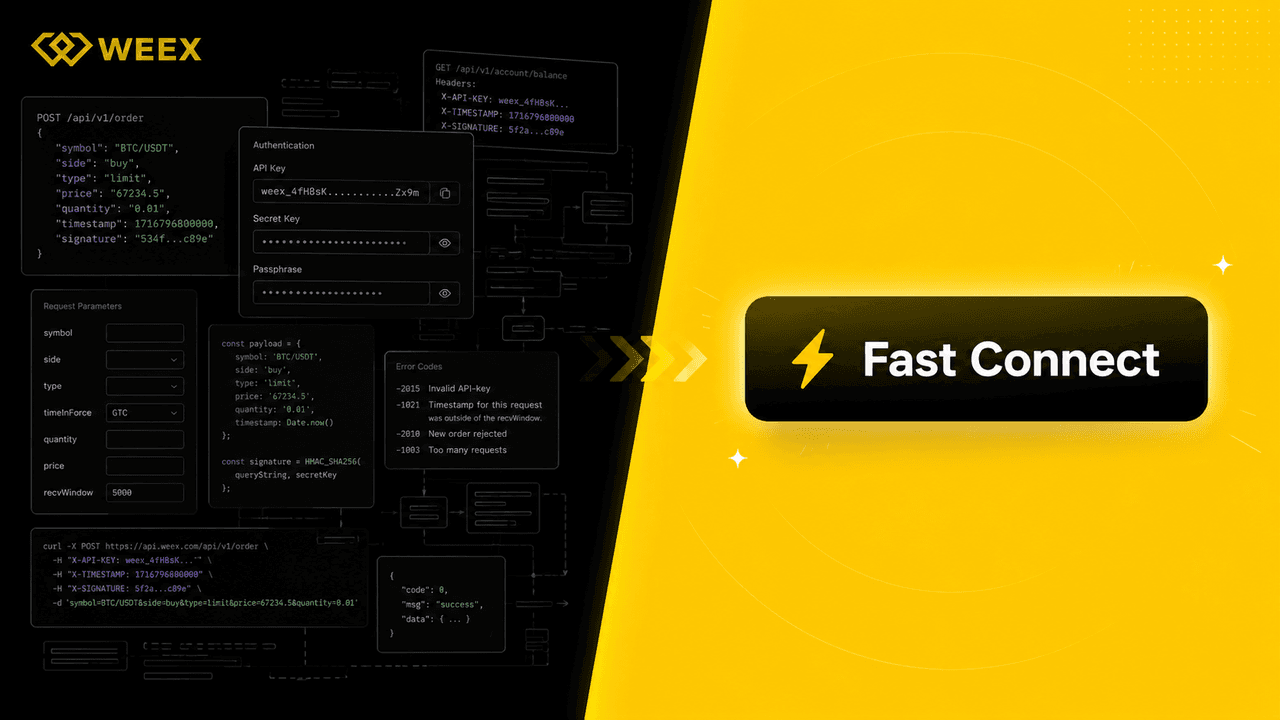
WEEX API Fast Connect: Turn Every Sign-In Into a Live Trader in Under 10 Seconds
WEEX API Fast Connect is a one-click OAuth authorization system that lets your users link their WEEX account without ever touching an API key. Frictionless onboarding, faster conversions, higher retention — built for WEEX Broker partners.
Bitcoin's dwindling exchange reserves don't pack the same bullish punch anymore

From Le Mans to the Rollercoaster: Carl Moon Takes On Portimão
Crypto world renowned KOL and racing driver Carl Moon, backed by WEEX, heads to the Ferrari Challenge Portugal round at the Algarve International Circuit, July 16–19, fresh off a podium finish at Le Mans. Here's why this race is one to watch.
Fast execution. Split-second accuracy. Security that never blinks. That's WEEX — and that's exactly how Carl races.

The Downfall of a Public Company: A $1.46 Billion Bet on WLFI, $540 Million Went to the Trump Family
Dragonfly Partner: BTC is Intergenerational Wealth, Optimistic About ETH and SOL
Goldman Sachs Calls to Go Long on Chinese AI: $4 Trillion Market Value Behind, Global Funds Only Allocated 1.2%
The New Landscape of Cryptocurrency in Europe: Why Germany Takes Center Stage?
Robinhood vs xStocks: Stock Tokenization Shouldn't Just Focus on Ticker On-Chain
Nexo launches crypto card in Argentina as Latin America push grows
Major Update for ChatGPT: Cross-Platform Functionality, One-Click Website Creation, and Lower Costs
BTC Challenges 64,000 After Breaking 63,000, Market Trading 'Manageable Risks'
Old Money in Crypto Shifts: Paradigm Raises $1.2 Billion, Half Bet on AI and Robotics
Bitdeer unveils $36M Nevada factory to shake up Bitcoin mining
Perplexity Fine-Tuned a Chinese AI Model to Match Claude Opus 4.8 at One-Third the Cost
Bank of Korea defends bank-first stablecoin plan amid bill deadlock
Contents
Latest articles




Latest coin listings on WEEX


