
Why Hasn't $160 Billion Stripe Gone Public?




Original Title: Fintech: What does Stripe at $160B mean for traditional IPOs?
Original Author: Michiel Milanovic, Fintech Blueprint
Original Translation: Bitpush News
Over the past two weeks, payment giant Stripe announced a Tender Offer, valuing the company at up to $159 billion.
Simultaneously, fintech infrastructure provider Plaid also completed a Tender Offer valuing the company at $80 billion.
A few days later, Robinhood's first Venture Fund I went public on the New York Stock Exchange (NYSE), allowing retail investors direct exposure to a basket of pre-IPO company equities.
These events are interconnected, reflecting a structural shift in how companies are raising funds, providing liquidity, and ultimately considering their path to the public markets.
Why is that?
Let's start with Plaid.
Founded in 2013, the company serves as an infrastructure layer connecting consumer bank accounts to financial apps like Venmo, Robinhood, and Chime. Apps pay Plaid to enable users to seamlessly link banks, verify credentials, and share account information. This is particularly valuable in the U.S. as regulations there do not mandate banks to share information with third parties (unlike the UK's Open Banking and the EU's PSD2).
Indeed, reportedly, half of all Americans have indirectly used Plaid's services through various financial apps. The company reached a peak valuation of $13.4 billion in 2021 and was once set to be acquired by Visa for $5.3 billion, but regulatory bodies ultimately blocked the deal. Repricing at $6.1 billion in April 2025, its latest Tender Offer of $80 billion reflects a resurgence in momentum. It is projected to reach $430 million in revenue by 2025, and 20% of new customers are now AI companies.

Meanwhile, Stripe was founded in 2010 by John Collison and Patrick Collison, becoming a payment giant.
Benefiting from the exponential growth of e-commerce over the past decade, the company recently reported astonishing performance for 2025. The total payment transaction volume reached $1.9 trillion, a 34% year-over-year increase, equivalent to about 1.6% of the global GDP. Although revenue is undisclosed, insiders estimate the revenue in 2024 to be at least $5 billion. Today, the annualized run rate (ARR) of just Stripe's Revenue Suite (including Stripe Billing, Invoicing, Tax, etc.) is expected to reach $1 billion.
In addition to its payment business, Stripe is actively expanding into cryptocurrency and Agentic Commerce, seeing it as a catalyst for online consumption. It acquired the stablecoin platform Bridge for $1.1 billion, bought the wallet infrastructure provider Privy, and is building Tempo—a payment-focused L1 blockchain currently being tested by Visa, Nubank, and Klarna. Its latest $159 billion acquisition offer price represents a 74% increase from last year.
ARK Invest Big
A Tender Offer is a secondary transaction that allows new or existing investors to buy stock directly from employees and early shareholders. It provides liquidity without diluting company equity or being subject to IPO regulations and structural burdens.
Both Stripe and Plaid are part of this larger trend: companies are successfully bypassing the public markets in favor of private transactions.
Reportedly, Anthropic is exploring a tender offer valued at over $350 billion, while Revolut recently completed an employee stock sale at a valuation of $75 billion.
In 2025, private secondary market transaction volume soared to $2.4 trillion, surpassing the $1.62 trillion in 2024. In contrast, globally, funds raised through traditional IPOs were about $140 billion.

As the private capital markets boom, the pace of companies going public has slowed down. The average wait time for a company to go public is now 16 years, a 33% increase from a decade ago. Over the past 12 years, the total assets in the private market have more than doubled to reach $22 trillion. Some of the world's most valuable companies, including SpaceX and OpenAI, remain private with valuations that rival or exceed those of large public companies.

This has led to two key market developments:
First, the emergence of a new capital market infrastructure layer. We recently analyzed the rise of platforms like Forge and EquityZen, which facilitate secondary trading of private company stock. Charles Schwab acquired Forge for $660 million in November, and Morgan Stanley acquired EquityZen in October (amount undisclosed).
Second, opening up the private market to retail investors. Robinhood's newly formed Ventures Fund I went public on the NYSE last Friday, raising $658 million and holding shares of large private companies like Ramp, Stripe, and Revolut. While not a first, Destiny Tech100 went public in March 2024, offering a portfolio of 100 VC-backed companies, including SpaceX and OpenAI. However, Robinhood can distribute directly to its 28 million users and, as seen in its public stock offering, has a track record of democratizing asset classes historically limited to institutional investors.

Additionally, the Trump administration signed an executive order last summer paving the way for $8.7 trillion in 401(k) retirement account investments in alternative assets such as cryptocurrency and the private market.
We see these as key catalysts for further growth, but they also expose some hidden risks.
One of them is the structural complexity behind buying private stock. Brokers often bundle these stocks into their special purpose vehicles (SPVs) and charge fees, and these SPVs sometimes hold positions in other instruments. The overlapping counterparty risks and fees may obscure the assets actually owned by the investors. The next macroeconomic downturn will be accompanied by the unraveling of SPV positions and the ensuing litigation.
There is also an issue of valuation transparency. The valuation of private companies is usually anchored to the most recent funding round, which may only happen once or twice a year. This limits price discovery and creates a gap between reported Net Asset Value (NAV) and the price the public markets are willing to pay.
The Financial Times recently reported that Robinhood's Ventures Fund I dropped 11% on its trading debut. Meanwhile, Destiny Tech 100's trading price had at one point reached nearly 20 times its NAV. This unpredictability is not ideal for retirement savings accounts.

Meanwhile, regulators are starting to push for reforms to enhance the attractiveness of the public markets. SEC Commissioner Hester Peirce expressed concerns about the private market in a February speech: "The pressures of going public have lessened, but the private markets lack equivalent price discovery mechanisms, accessibility, and liquidity."
SEC Chair Paul Atkins recently proposed a three-pillar plan to "make IPOs great again" – his words – by easing disclosure requirements and reforming securities litigation. The implementation of these reforms remains to be seen.
Setting aside private transactions, IPOs have indeed seen a significant resurgence in 2025. Eleven VC-backed fintech companies, including Circle and Klarna, have gone public, with more in the pipeline. Kraken and Bitgo have confidentially filed, while companies like Ramp and Gusto are preparing by cleaning up cap tables, hiring new CFOs, or engaging with investment banks. F-Prime estimates that the total market cap of fintech could grow from $947 billion to $1.2 trillion.

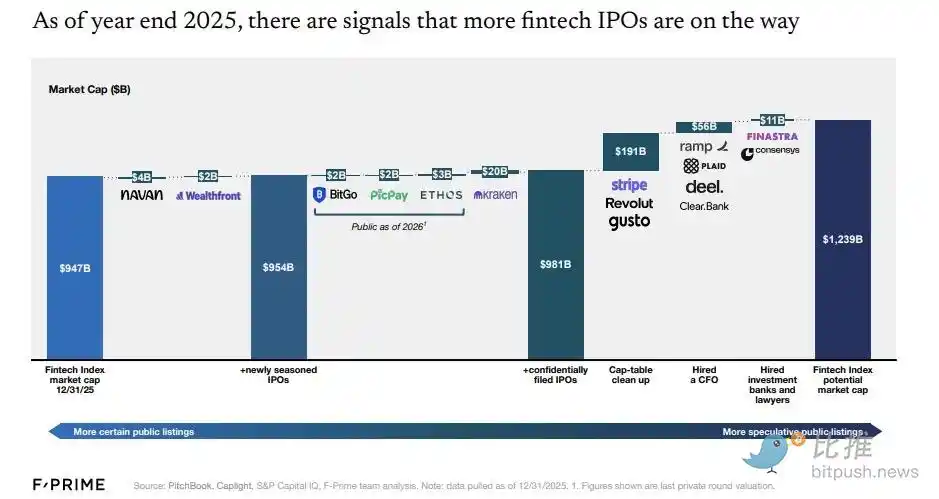
Whether these companies can achieve their desired prices is another matter. By the end of the year, only 2 out of the 11 companies had trading prices above their IPO prices. Chime, once valued privately at $25 billion, went public at $13.5 billion. Klarna went public at $17.3 billion but fell to $10.9 billion by year-end.
With escalating geopolitical tensions and uncertain macro outlooks, those still on the sidelines may find that a tender offer is the path of least resistance. At least for now, the private market's liquidity remains ample enough to absorb this batch of unicorns.
You may also like
NeoSoul announced plans to integrate with the OKX Agentic Wallet, promoting AI agents' participation in the on-chain economy
Raising interest rates to protect STRC and selling coins to maintain credit, this time the strategy has chosen the two most expensive paths
Why Is Bitcoin Lagging Stocks in 2026? AI Stocks, ETF Outflows, and the Nasdaq Rally Explained
Morning Report | Samsung announces a 265.5 trillion won investment plan, focusing on semiconductor and AI computing power data centers; Vitalik publishes an article detailing the entire technology tree behind the confusion protocol (iO) mainline
What you bought on CEX is really not US stocks: Analyzing the 94% liquidation monopoly and the evaporation of equity under a five-layer pipeline
In such a crowded cross-border payment arena, where is the next stop for the future?
Why Is Bitcoin Down in 2026? What We Can Learn From 2022
The large models in the United States are moving towards closure in the name of security
From the white-haired stock god to the billionaire fund mogul, the smart people shorting Nvidia are all getting rich using the same framework
Morning Report | CoinEx becomes a key hub for Iran to evade sanctions, involving over $3.8 billion in funds; Kalshi seeks a new round of financing, with a valuation potentially rising to $40 billion
Global Launch: As predictions become the most scarce asset in the AI era, Manadia is defining the next generation of the value internet
Why do cryptocurrency projects always like to change their names?
Who is footing the bill for the $64 billion accounting frenzy?
I never expected that the first application of AI x Crypto would be in security auditing
What is your view on Binance's competitive advantages?
ETH has entered a non-consensus phase, and the turning point is approaching!
The shift in the cloud of the air: from despising stablecoins a year ago to the high-profile entry of capital today
The survival dilemma of small and medium exchanges behind the withdrawal anomalies exposed by AscendEX
NeoSoul announced plans to integrate with the OKX Agentic Wallet, promoting AI agents' participation in the on-chain economy
Raising interest rates to protect STRC and selling coins to maintain credit, this time the strategy has chosen the two most expensive paths
Why Is Bitcoin Lagging Stocks in 2026? AI Stocks, ETF Outflows, and the Nasdaq Rally Explained
Morning Report | Samsung announces a 265.5 trillion won investment plan, focusing on semiconductor and AI computing power data centers; Vitalik publishes an article detailing the entire technology tree behind the confusion protocol (iO) mainline
What you bought on CEX is really not US stocks: Analyzing the 94% liquidation monopoly and the evaporation of equity under a five-layer pipeline
In such a crowded cross-border payment arena, where is the next stop for the future?