
Crude Oil Surges 25%, Hyperliquid Unfolds On-Chain Showdown



Original Title: "Crude Oil Surges 25%, Hyperliquid Witnessing On-chain Showdown"
Original Author: angelilu, Foresight News
"The friend who shorted oil is completely lit up."
On the morning of March 9, when WTI crude oil touched $108 per barrel, on-chain analyst Ai Yi tweeted this. The top account on Hyperliquid's leaderboard was facing an unrealized loss approaching $3.4 million, with a liquidation price set at $120.76.
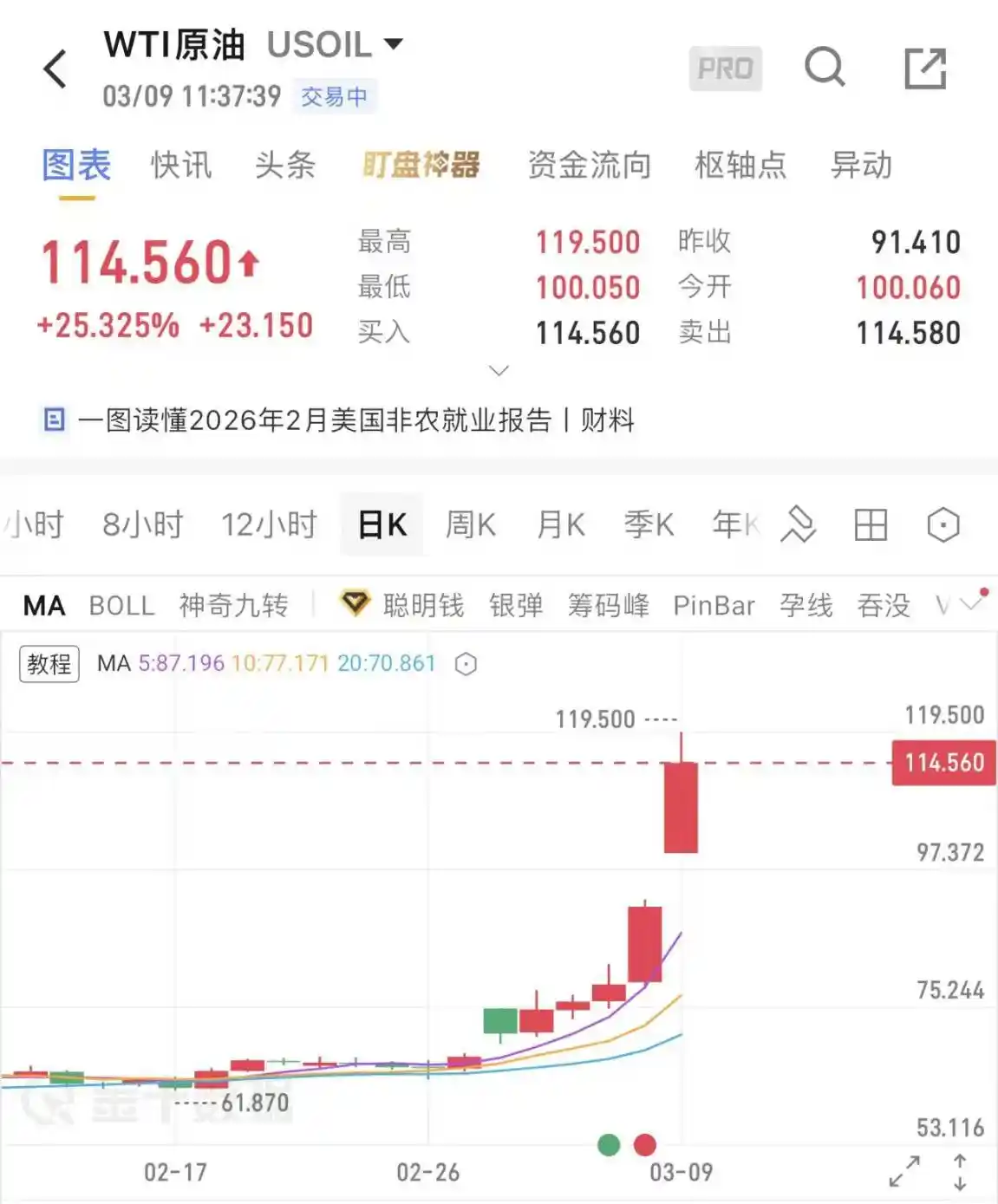
At the time of writing, the WTI crude oil contract price had reached a intraday high of $119.5, currently trading at $114.5, up over 25% from last Friday's close.
Due to a Strait, Crude Oil Skyrockets Over 40% in a Week
The story starts with the Strait of Hormuz in Iran.
By March 9, the Strait of Hormuz had been almost completely blocked for the seventh consecutive day. This chokepoint, which carries about 20% of the world's oil supply, came to a standstill, causing a seismic shift in the market. By March 9, the WTI crude oil price had skyrocketed in just one week, setting a rare volatility record in recent years, with an increase of over 40% from before the conflict.
The shockwave spread rapidly. The Nikkei index fell 5.4% in a single day, marking the largest drop since the tariff turmoil; the South Korean KOSPI plummeted 7%; the German DAX fell over 3%. Bitcoin was not immune either, dropping below $66,000, with the crypto market liquidating $120 million within an hour. The crypto fear and greed index dropped to 12, putting the market into "extreme fear" territory.
But on Hyperliquid, another war was unfolding.
Three Stories of Shorting Crude Oil
In the on-chain community, CBB (@Cbb0fe) is no stranger. Several months ago, he publicly formed a team dedicated to "hunting" another whale, @qwatio. This time, he himself became the prey.
According to Lookonchain monitoring, CBB shorted 127,175 xyz:CL (WTI Crude Oil Synthetic Contract) at an average price of $78.37, with a nominal value of approximately $13.78 million. As the oil price surged, his unrealized loss had reached $3.81 million, with a liquidation price hanging at $120.76.
There is still room for a few cents to reach that number. But no one knows when the Iran situation will cool down.
Another account, "2 frères 2 fauves," is in a similarly dangerous situation. He entered a short position at $78.36 and currently holds 12,717 CL tokens, with a nominal value of approximately $13.37 million, making him the top holder of CL contracts on Hyperliquid. He is unrealized loss of $3.4 million, with a liquidation price also at $120.76.
Even more dramatic is the ordeal of the whale 0x8Af7. He shorted 72,179 CL tokens (about $7.8 million), and as the oil price rose, his short position was forcibly liquidated entirely, resulting in a loss of over $1.55 million.
However, shortly after the liquidation was completed, in less than a few hours, he immediately reopened a new short position of 60,166 CL tokens, with a nominal value of $6.48 million.
Was it a misjudgment or an unchanging gambling nature? Perhaps both. But the choice itself has already illustrated a certain quality of on-chain high-leverage trading: Liquidation is not the end but merely the end of the previous game.
There are also winners, the other side of Sky DAO
In the same Hyperliquid, at the same time, Sky (formerly MakerDAO) co-founder Rune Christensen was smiling on the other side.
On-chain analyst EmberCN revealed that RuneKek (Rune's on-chain account) had a long position of about $7.82 million in an oil contract, with a cost of around $93. As of today, the oil price has reached $109, and his unrealized profit has exceeded $1.36 million.
What is even more noteworthy is his portfolio strategy: While being long on oil, he also shorted some ETH and XYZ100 (a US stock index mapping contract). This made his strategy more like a geo-conflict hedge logic - oil benefits from a war premium, while stocks and cryptocurrencies are pressured by risk aversion sentiment. By positioning on both sides simultaneously, he hedged the risk of one-sided bets.
Rune Christensen is a DeFi protocol founder who has built a macro hedge portfolio with on-chain perpetual contracts. This fact is more worthy of attention than how much money he made.
On-chain Commodity Trading: New Tools, Old Lessons
This round of oil price movements has brought a once inconspicuous topic to the forefront: on-chain commodity trading.
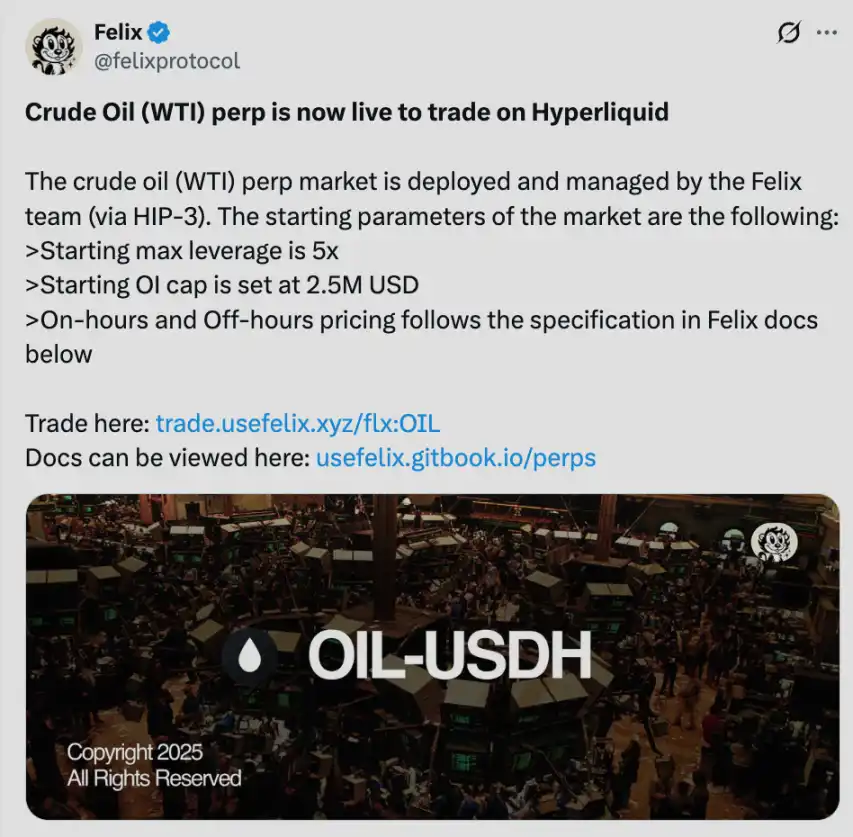
The crude oil on Hyperliquid was launched on January 9, 2026, by the Felix Protocol (the HIP-3 Market Deployer on Hyperliquid), which was about two months ago. The initial parameters were a maximum of 5x leverage and a maximum unfunded balance of $2.5 million, making it an early small-scale launch that saw a surge in trading volume only after the Iran Strait blockade.
Platforms like Phantom have also gradually launched perpetual contracts for traditional bulk commodities like crude oil and gold. In theory, anyone only needs a single wallet to trade commodity futures like trading Bitcoin, without the need for a traditional futures account or a broker.
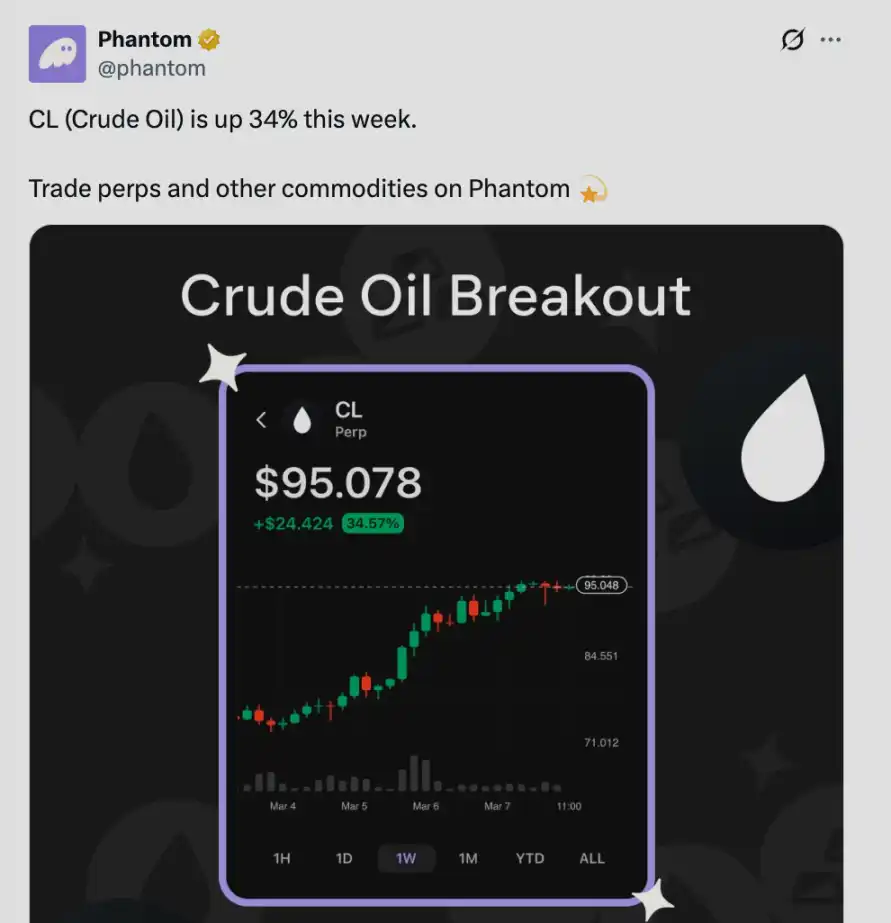
This is true financial democratization. But the other side of the coin is equally true.
The traditional bulk commodity futures market has strict margin requirements, circuit breakers, position limits, and risk management teams from brokers constantly monitoring positions. The rules of on-chain perpetual contracts are much simpler: if the position's value falls to the liquidation line, the system automatically liquidates it, without any phone reminders or human intervention.
The liquidation prices for CBB, 2 Frères 2 Fauves, are all around $120.76, which is not a random number but the "safety margin" they calculated when they opened their positions. Within normal oil price fluctuations, there was over $50 of cushioning from the entry price of $78, which seemed quite ample.
However, what they did not anticipate was that a geopolitical crisis could cause a 50% surge in oil prices within 72 hours.
It wasn't a flawed strategy but a black swan event. The issue is that there is no mechanism on-chain to give you a breather when the black swan lands.
When DeFi Meets the Hormuz Strait
The connection between the crypto market and traditional geopolitics is unfolding faster than anyone expected.
Hyperliquid users now need to keep an eye on the latest developments in the Iran Hormuz Strait, while DeFi OGs are hedging war risks with on-chain derivatives.
As the categories of on-chain bulk commodities and on-chain synthetic stock contracts continue to expand, the depth of exposure of on-chain players to macro risks will only increase. In the traditional financial world, this is called "global macro strategy," requiring a professional team and a robust risk management system. On-chain, it's called "an individual's position."
You may also like
Argentina vs Cape Verde: When a Record-Breaking Legend Meets an Unbreakable Underdog
WEEX exclusive pre-match analysis of Argentina vs Cape Verde, exploring Messi-led Argentina’s dominance and Cape Verde’s historic defensive breakout, with a breakdown of volatility, structure, and match dynamics.
How does Gate redo "buying and selling stocks" from the cryptocurrency world to the stock market?
Former ByteDance employee's account: How I started with two Pinduoduo hard drives and made six times the profit with Seagate to achieve financial freedom?
Visa and Mastercard join 140 giants to launch a new stablecoin, but the impact on the market landscape may still be limited
WEEX Launches Depth Chart for Spot Trading
MiCA reshuffle begins, Binance temporarily bids farewell to the EU
Raising interest rates to protect STRC and selling coins to maintain credit, this time the strategy has chosen the two most expensive paths
Morning Report | Samsung announces a 265.5 trillion won investment plan, focusing on semiconductor and AI computing power data centers; Vitalik publishes an article detailing the entire technology tree behind the confusion protocol (iO) mainline
In the era of AI, what is left of Bitcoin?
NeoSoul announced plans to integrate with the OKX Agentic Wallet, promoting AI agents' participation in the on-chain economy
Why Is Bitcoin Lagging Stocks in 2026? AI Stocks, ETF Outflows, and the Nasdaq Rally Explained
What you bought on CEX is really not US stocks: Analyzing the 94% liquidation monopoly and the evaporation of equity under a five-layer pipeline
In such a crowded cross-border payment arena, where is the next stop for the future?
Why Is Bitcoin Down in 2026? What We Can Learn From 2022
The large models in the United States are moving towards closure in the name of security
From the white-haired stock god to the billionaire fund mogul, the smart people shorting Nvidia are all getting rich using the same framework
Morning Report | CoinEx becomes a key hub for Iran to evade sanctions, involving over $3.8 billion in funds; Kalshi seeks a new round of financing, with a valuation potentially rising to $40 billion
Global Launch: As predictions become the most scarce asset in the AI era, Manadia is defining the next generation of the value internet
Argentina vs Cape Verde: When a Record-Breaking Legend Meets an Unbreakable Underdog
WEEX exclusive pre-match analysis of Argentina vs Cape Verde, exploring Messi-led Argentina’s dominance and Cape Verde’s historic defensive breakout, with a breakdown of volatility, structure, and match dynamics.
How does Gate redo "buying and selling stocks" from the cryptocurrency world to the stock market?
Former ByteDance employee's account: How I started with two Pinduoduo hard drives and made six times the profit with Seagate to achieve financial freedom?
Visa and Mastercard join 140 giants to launch a new stablecoin, but the impact on the market landscape may still be limited
WEEX Launches Depth Chart for Spot Trading
MiCA reshuffle begins, Binance temporarily bids farewell to the EU


